
How a Small Team Made Minecraft Dungeons in Unreal Engine

About twenty developers shipped a multiplayer action-adventure in Unreal Engine — source access, quick iteration, and a scope that fits a small team.

Studio Mojang Studios
Engine Unreal Engine
Category Game Development
Source Unreal Engine
How a Small Team Made Minecraft Dungeons in Unreal Engine

Overview

Mojang Studios built Minecraft Dungeons on Unreal Engine 4 with a team of roughly twenty developers. They chose UE4 over their own internal engine because it delivered the animation quality, VFX fidelity, and multiplayer infrastructure they needed for a cooperative action-adventure — something their proprietary tech couldn't match.

The project pivoted from single-player to co-op mid-development, a shift that would have derailed a custom engine build. UE4's source code access let them customize for multiple platforms — Xbox, PlayStation 4, Nintendo Switch, and PC — while keeping divergences from mainline engine updates minimal.

Curated by Feative Studios
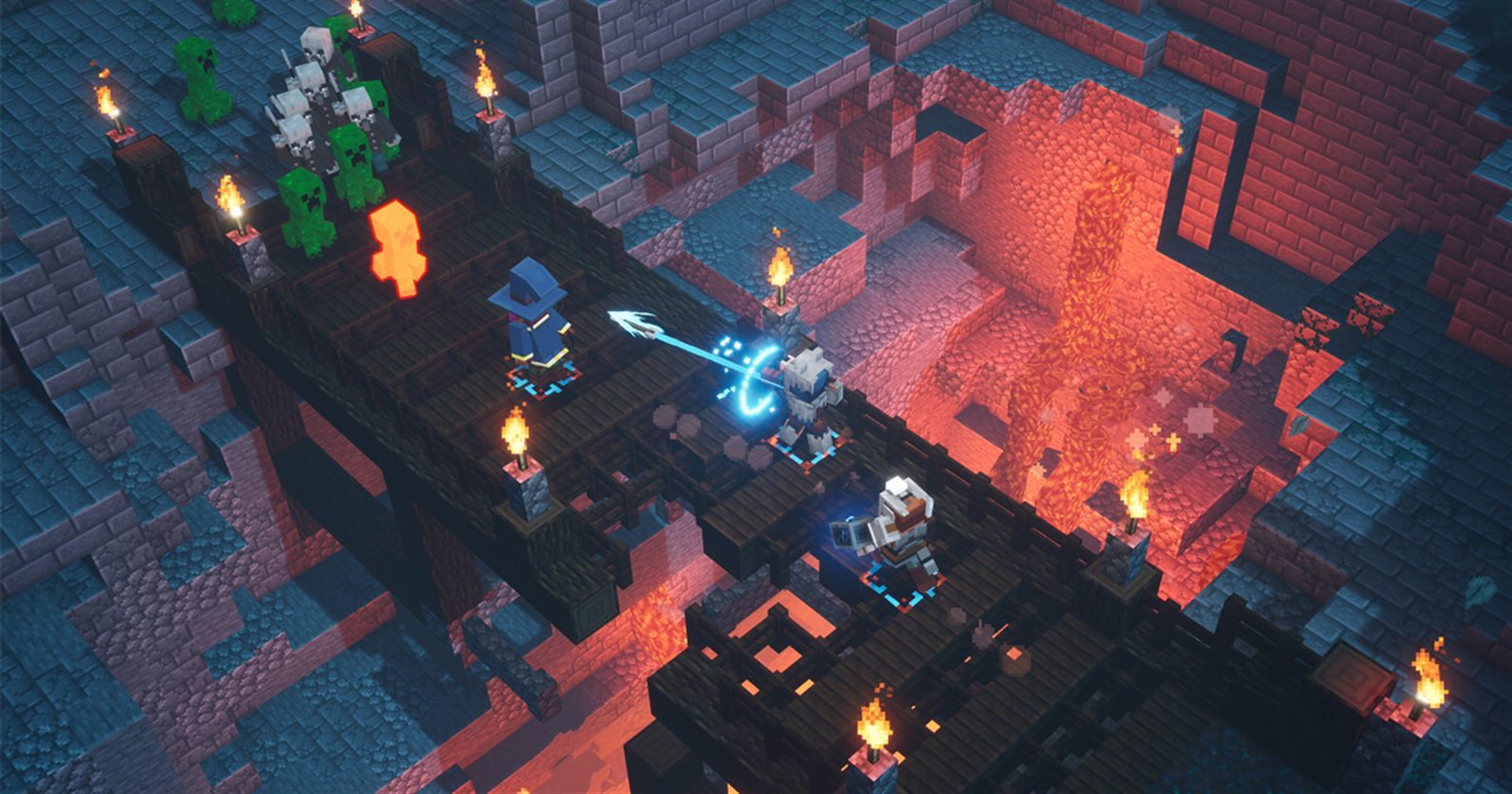
How a Small Team Made Minecraft Dungeons in Unreal Engine

Challenge

A twenty-person team needed to ship an action-adventure with VFX quality on par with larger studios. Mojang's own engine couldn't deliver the particle effects, skeletal animation, or real-time lighting the genre demanded. The game had to launch across four platforms simultaneously. Midway through development, the team pivoted from a single-player experience to a fully cooperative one — adding networking requirements that weren't in the original scope.

Solution

UE4's built-in multiplayer framework handled both online and couch co-op networking without the team needing to write netcode from scratch. Source code access let them make platform-specific modifications — adapting input systems, performance profiles, and platform certification requirements — while staying close enough to mainline UE4 to receive engine updates without massive merge conflicts.

The small team focused on gameplay, level design, and art while the engine handled rendering, physics, audio, and networking infrastructure.

Result

Minecraft Dungeons shipped across Xbox, PlayStation 4, Nintendo Switch, and PC. The team achieved full dungeon-crawler scope — procedurally influenced levels, four-player co-op, and a complete loot loop — that would have been impossible for twenty people building custom technology. The pivot to multiplayer happened mid-development without derailing the ship date, because UE4's networking layer absorbed that complexity.

Key Takeaways

Takeaway 1Source code access acts as insurance: "own your technology or have the ability to change everything" — without it, platform-specific needs become blockers.
Takeaway 2UE4's multiplayer tooling freed a twenty-person team from writing netcode for online and couch co-op, letting them focus entirely on gameplay feel.
Takeaway 3A franchise with over 200 million copies shipped across the series was brought to a new genre by twenty people running on a stock engine — proving scale doesn't require a custom tech stack.

Original Study

Source How a Small Team at Mojang Studios Made Minecraft Dungeons in Unreal Engine

An Unreal Engine spotlight interview with Mojang Studios during development of Minecraft Dungeons.

View the Original Study
Keep Exploring

Want results like this?

Whether it is a full product or targeted engineering support, Feative Studios plugs into your pipeline with no friction.